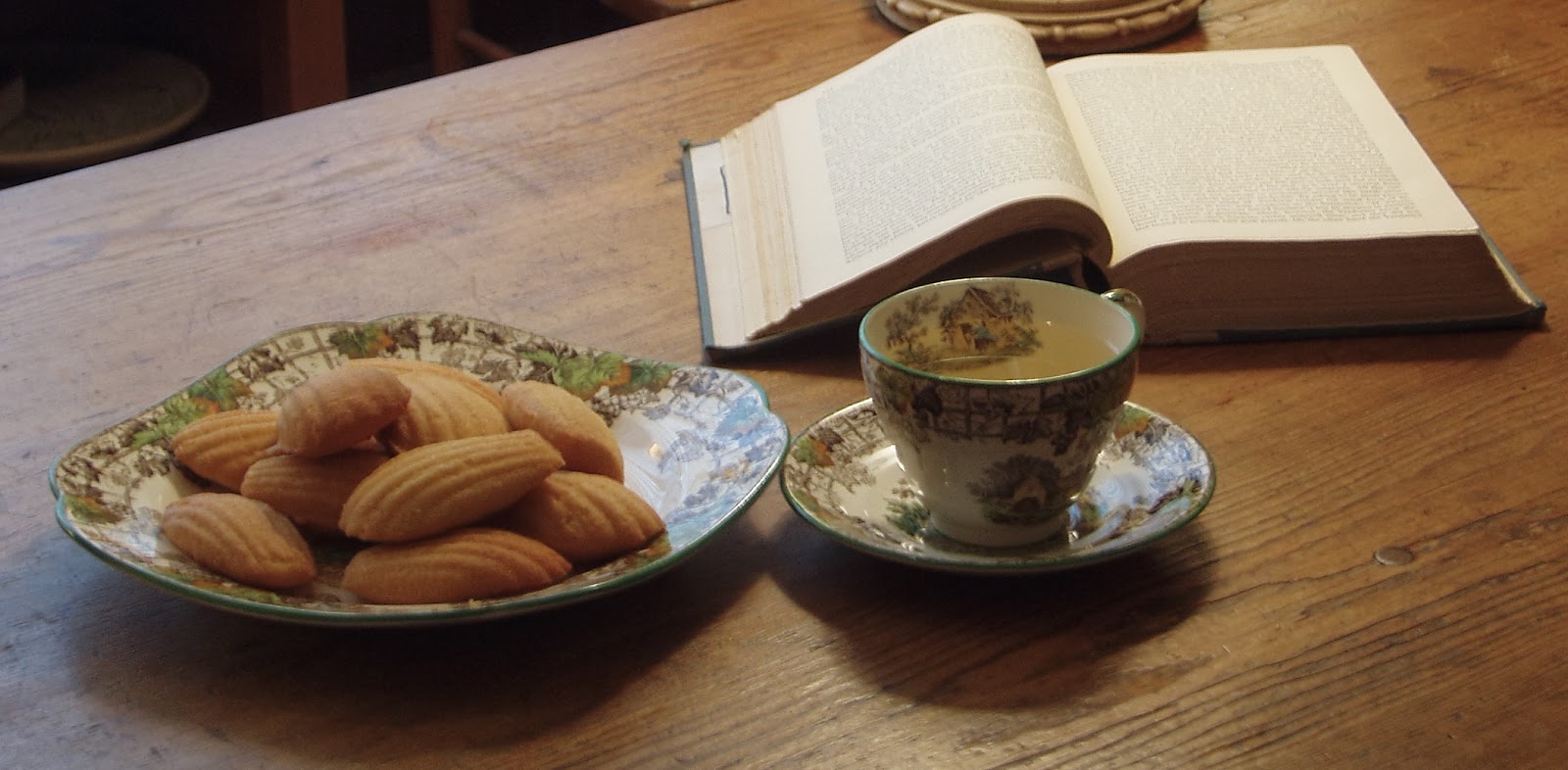
These are my favorite lines from Marcel Proust's In Search of Lost Time - Volume I - Swann's Way. It describes an event where eating tea soaked madeleine triggers unexpected strong vivid remembrance of a childhood memory of eating tea soaked madeleine. Such involuntary memories allow the timeline of the story to randomly shift from past, further past and present. I think that human memories are non linear and often memories of the past is intervened with memory of further past, having gap in between, and that memory is sometimes connected with the present memories. Similar literary device of involuntary memories and non-linearity of memories is depicted in Swedish director Ingmar Bergman's masterpiece work "Wild Strawberries". The main character experiences series of involuntary memories in his vivid dreams and it is also triggered by seeing his old childhood home. If you like the following few passages then I recommend you to read In Search of Lost Time (it is Proust's monumental work consisting of seven volumes, swann's way is the first volume) and watch Ingmar Bergman's film "Wild Strawberries".
---------------------------------------------------------------------------------------------------------------------
Many years had elapsed during which nothing of Combray, save what was comprised in the theatre and the drama of my going to bed there, had any existence for me, when one day in winter, on my return home, my mother, seeing that I was cold, offered me some tea, a thing I did not ordinarily take. I declined at first, and then, for no particular reason, changed my mind. She sent for one of those squat, plump little cakes called "petites madeleines," which look as though they had been moulded in the fluted valve of a scallop shell. And soon, mechanically, dispirited after a dreary day with the prospect of a depressing morrow, I raised to my lips a spoonful of the tea in which I had soaked a morsel of the cake. No sooner had the warm liquid mixed with the crumbs touched my palate than a shudder ran through me and I stopped, intent upon the extraordinary thing that was happening to me. An exquisite pleasure had invaded my senses, something isolated, detached, with no suggestion of its origin. And at once the vicissitudes of life had become indifferent to me, its disasters innocuous, its brevity illusory – this new sensation having had on me the effect which love has of filling me with a precious essence; or rather this essence was not in me it was me. An exquisite pleasure had invaded my senses, something isolated, detached, with no suggestion of its origin. And at once the vicissitudes of life had become indifferent to me, its disasters innocuous, its brevity illusory - this new sensation having had on me the effect which love has of filling me with a precious essence; or rather this essence was not in me it was me. I had ceased now to feel mediocre, contingent, mortal. Whence could it have come to me, this all-powerful joy? I sensed that it was connected with the taste of the tea and the cake, but that it infinitely transcended those savours, could, no, indeed, be of the same nature.
I drink a second mouthful, in which I find nothing more than in the first, then a third, which gives me rather less than the second. It is time to stop; the potion is losing it magic. It is plain that the truth I am seeking lies not in the cup but in myself... And I begin to ask myself what it could have been, this unremembered state which brought with it no logical proof, but the indisputable evidence, of its felicity, its reality, and in whose presence other states of consciousness melted and vanished. I decide to attempt to make it reappear. I retrace my thoughts to the moment at which I drank the first spoonful of tea. I rediscover the same state, illuminated by no fresh light. I ask my mind to make one further effort, to bring back once more the fleeting sensation.
..And suddenly the memory revealed itself. The taste was that of the little piece of madeleine which on Sunday mornings at Combray (because on those mornings I did not go out before mass), when I went to say good morning to her in her bedroom, my aunt Léonie used to give me, dipping it first in her own cup of tea or tisane... But when from a long-distant past nothing subsists, after the people are dead, after the things are broken and scattered, taste and smell alone, more fragile but more enduring, more unsubstantial, more persistent, more faithful, remain poised a long time, like souls, remembering, waiting, hoping, amid the ruins of all the rest; and bear unflinchingly, in the tiny and almost impalpable drop of their essence, the vast structure of recollection...
...And as soon as I had recognized the taste of the piece of madeleine soaked in her decoction of lime-blossom which my aunt used to give me (although I did not yet know and must long postpone the discovery of why this memory made me so happy) immediately the old grey house upon the street, where her room was, rose up like a stage set to attach itself to the little pavilion opening on to the garden which had been built out behind it for my parents (the isolated segment which until that moment had been all that I could see); and with the house the town, from morning to night and in all weathers, the Square where I used to be sent before lunch, the streets along which I used to run errands, the country roads we took when it was fine...
...The sight of the little madeleine had recalled nothing to my mind before I tasted it. And all from my cup of tea...
(You can read the chapter here:
http://www.haverford.edu/psych/ddavis/p109g/proust.html )